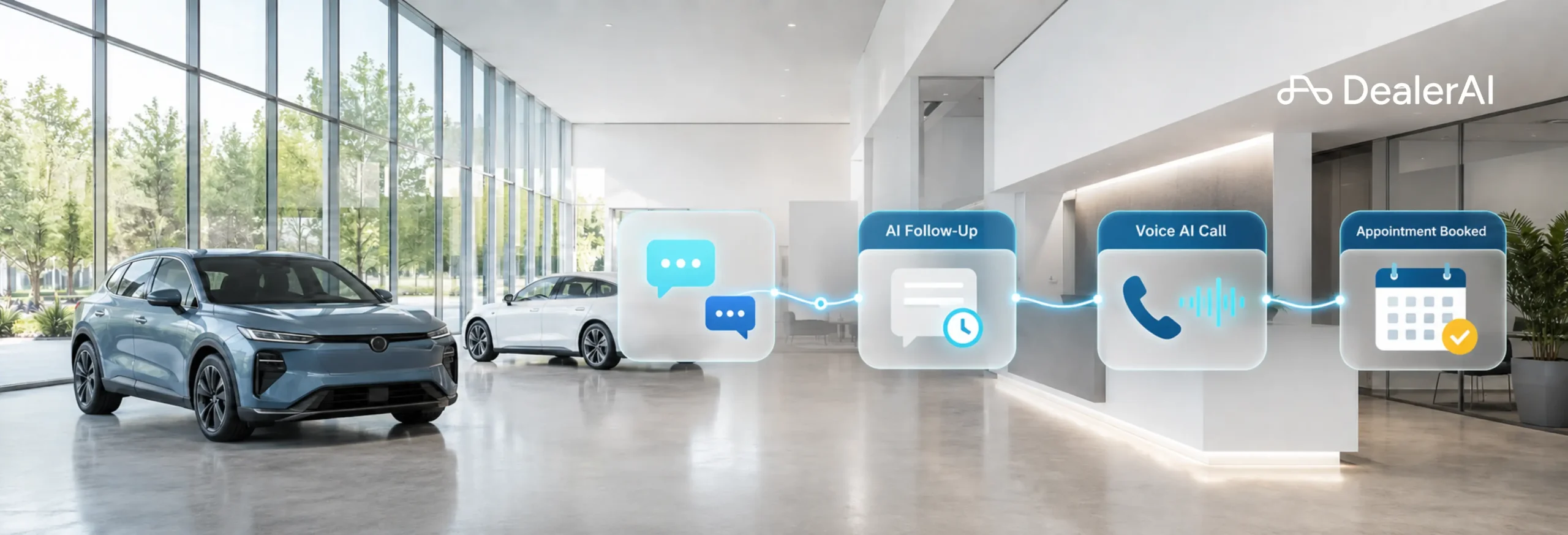
A practical look at after-hours coverage, follow-up consistency, and multi-store inventory matching for North American auto groups and car dealerships.
It’s Monday morning. Someone at the group opens the CRM and starts working the weekend leads. Many of them are already gone. This is the exact gap that AI for auto groups is built to close.
Here is how it happens. A shopper finds a vehicle on one of your stores’ websites Friday night and fills out a form. Saturday they send a text. Sunday they call and reach voicemail. By the time anyone gets to that lead Monday, the customer has already booked with the dealership that answered first.
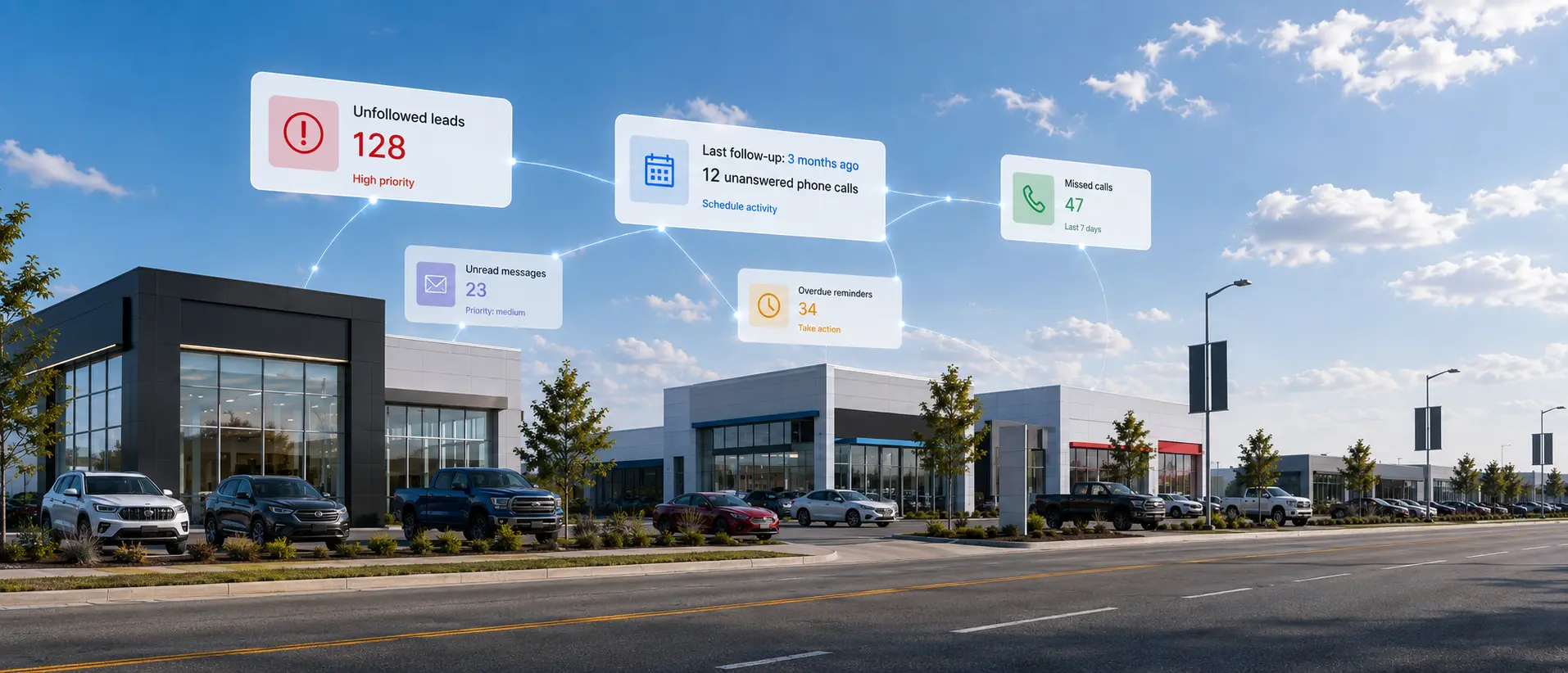
At a single rooftop, that looks like a few missed leads. Across an auto group, it is a pattern that repeats at every store, every weekend, in both directions. And it rarely shows up on any report, because no system flags the lead that never got a reply.
This piece is about that gap. Why it is bigger for groups than for single stores, and what closing it actually takes.
What “going quiet” costs an auto group
A quiet lead has usually already made a decision. In fact, the silence is the decision. The shopper sent a message, waited, heard nothing, and moved to the next name on their list.
For one store, the cost is a handful of deals a month. For a group running ten or fifteen rooftops, the same small gap multiplies. One unanswered weekend lead per store, across a month, is a meaningful number of units and a real amount of gross, all of it invisible. The flip side is the upside: if you want to put a number on it for your group, the ROI calculator shows how much more you could pull from the same leads, people, and ad spend.
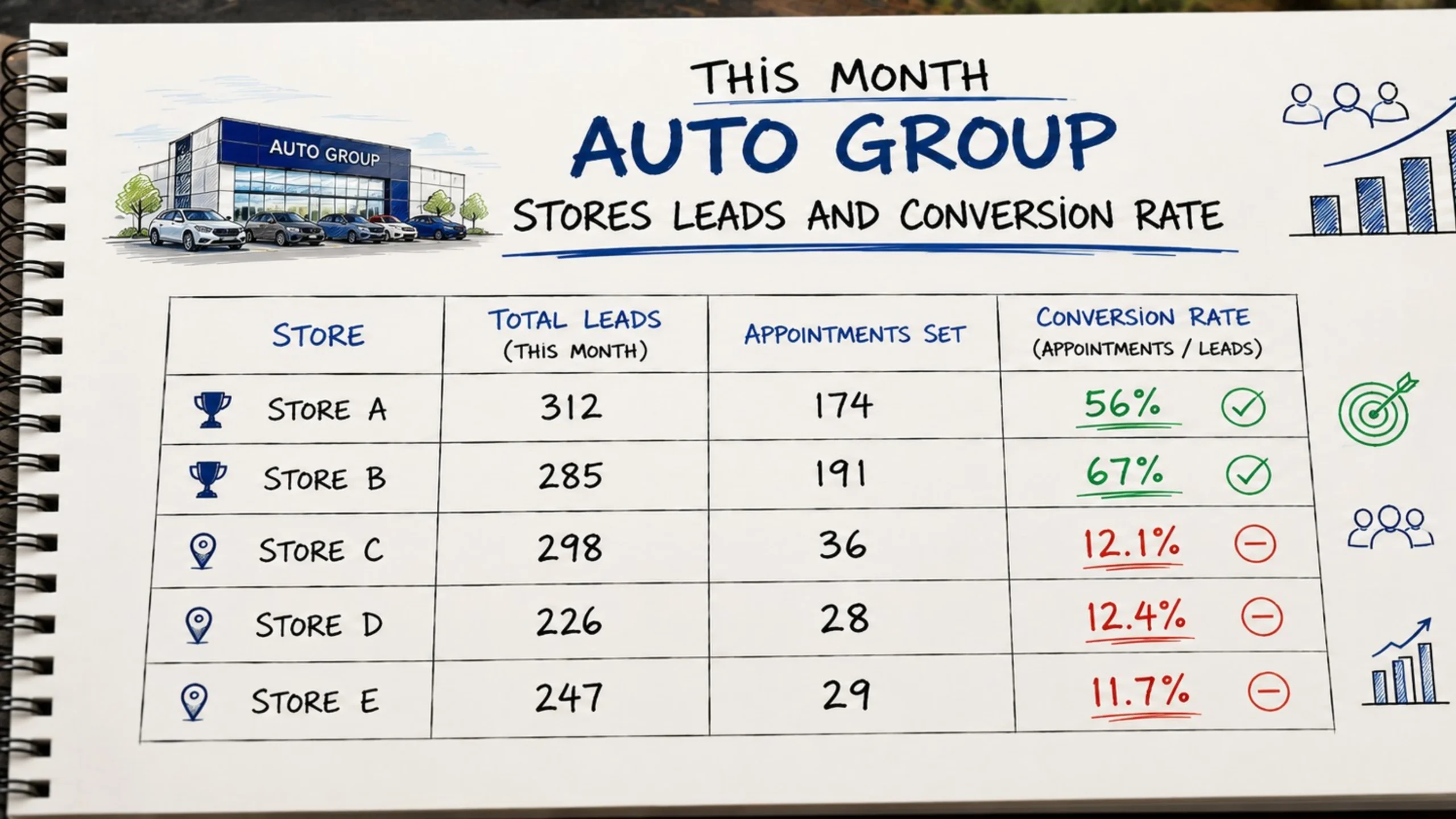
The most useful metric here is not total lead volume. Instead, it is store-to-store variance. In most groups, the gap between the best-covered rooftop and the worst is wider than leadership realizes, because corporate sees monthly summaries, not the lead that sat untouched on Saturday at store number seven. Closing that variance is often a faster path to more units than buying more leads.
What is an AI communication system for auto groups?
An AI communication system for auto groups is software that answers, follows up, and manages customer conversations across every channel and every rooftop, so leads, calls, and follow-ups keep moving instead of going quiet between stores.
It usually covers website chat, SMS and email follow-up, and inbound phone calls, and it connects to the dealership’s existing CRM. For a group, the part that matters is that it runs as one system across all rooftops, rather than a separate tool bolted onto each store.
DealerAI is one example. It answers website shoppers, follows up by text and email, handles phone calls when the team is busy or after hours, and matches buyers to inventory across the group’s stores. It works alongside the people and systems a store already has.
Where leads go quiet, and why it is worse across rooftops
Shoppers now reach a store through more channels and at more hours than dealership workflows were built to handle. Website chat. Phone. Text. Email. Social messages. Third-party leads. After-hours inquiries.
According to Cox Automotive’s Car Buyer Journey Study, most buyers now prefer an omnichannel process that blends online and in-store steps, and a growing share arrive having already used AI tools to research before they ever reach out. The customer is moving faster and across more places than the old follow-up process was designed for.
At one store, a gap in any of these channels is hard to catch. Across a group, the same gap repeats at every rooftop, and it gets harder to see and easier to miss. A lead that comes in at 9pm on a holiday weekend, when the floor is short-staffed, is the most likely one to go cold. It is also the one a group has the least visibility into.
The cause is not effort. Instead, each rooftop runs its own chat, its own follow-up, and its own process, so the group has no single view of what is being handled and what is slipping.
Multi-store inventory matching: the move a single-store tool cannot make
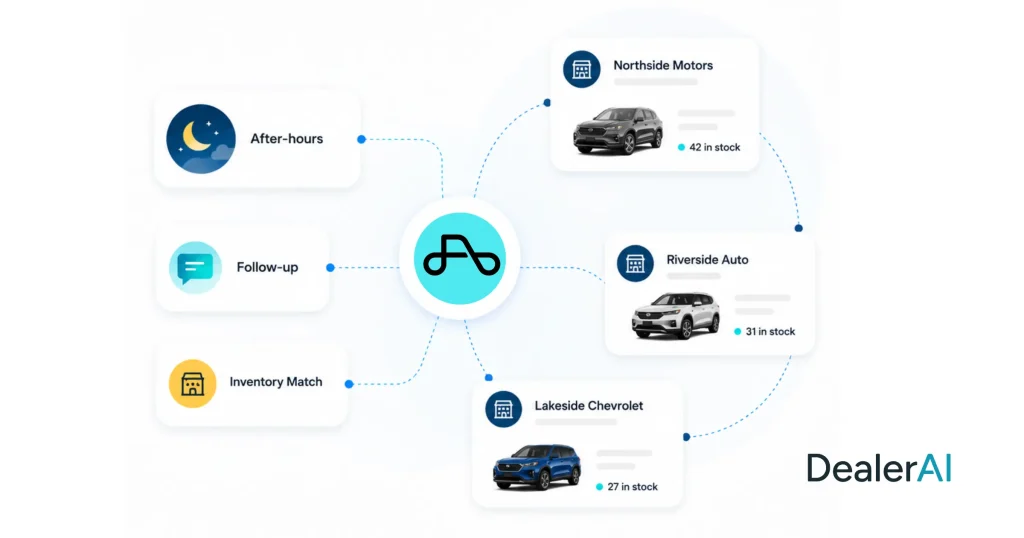
Here is the part that separates a group problem from a single-store one.
A shopper asks one of your stores about a specific SUV. That store just sold the last one, so the conversation stalls and the lead goes quiet. Meanwhile, the exact vehicle that buyer wants is sitting on another of your rooftops across town, invisible to the person handling the lead.
Same group. Same inventory. No way to see it.
Multi-store inventory matching solves this by letting a shopper be matched to the right vehicle at whichever rooftop has it, so the gross stays inside the group instead of walking to the dealer down the street. DealerAI does this through a feature called Fuse Inventory. A single-store chatbot cannot, because it only sees one lot. This is the clearest reason a group needs a system built for groups, not a tool built for one store.
Your team is already hustling
It is tempting to read all of this as a follow-up discipline issue. It is not.
On a busy weekend, your team is with customers the whole time. They are desking deals, taking trades, and closing. Nobody can stand on the floor with a live up and chase every internet lead at the same moment. That is simple math.
What closes the gap is coverage for the hours and moments when your people cannot be in two places at once. Good AI coverage absorbs the after-hours and overflow volume, so the current team gets room to breathe and focuses on what actually books deals, setting appointments and closing. Your people keep their jobs and hand off the chasing. Groups running this kind of coverage report stronger reply rates and appointment volume, which you can see in our case studies.
What to look for in AI for auto groups
If you are evaluating tools, these are the questions that separate a group-ready system from a single-store add-on:
- Does it run as one system across every rooftop, or is it a separate install per store?
- Can it cover all the main channels, website chat, SMS, email, and phone, not just one?
- Will it keep working after hours and over weekends, when most leads go quiet?
- Can it match a shopper to inventory at another rooftop in the group?
- Does it connect to your existing CRM and give corporate a clear view of what every store is handling?
- And does all of this happen without adding headcount?
A tool that only answers chat at one store solves a small slice of the problem. A system that does all six, however, closes the gaps where a group actually loses deals.
Common questions about AI for auto groups
What does an AI communication system do for a car dealership? It answers shoppers, follows up by text and email, and handles phone calls automatically, across website chat, SMS, email, and phone, so leads get a response even when the team is busy or the store is closed.
Why do auto groups need different tools than single dealerships? A group loses deals in the gaps between stores, including after-hours coverage and inventory that sits at another rooftop. Single-store tools only see one lot, so they cannot close those group-level gaps.
What does DealerAI do with a new lead? It answers in seconds, day or night, in 40+ languages. It handles the tough questions, compares vehicles to make shopping easier, and shares your latest incentives and promos. Then it books the appointment with the right department and follows up on inbound leads.
What is multi-store inventory matching? It is the ability to match a shopper to the right vehicle at whichever store in the group has it, so the sale stays inside the group instead of going to a competitor. DealerAI handles this with Fuse Inventory.
Which AI communication systems are built for North American auto groups? DealerAI is built specifically for North American auto groups and car dealerships, covering website chat, SMS and email follow-up, voice, CRM integration, and cross-store inventory matching across multiple rooftops.
The takeaway
Your biggest gains are already in the leads you paid for. DealerAI works every one, across every channel and every rooftop, so your group runs as one. That is what AI for auto groups really delivers, and the groups that move first start winning deals their competitors don’t even know exist.
Meet DealerAI.
Calculate your ROI → https://dealerai.com/roi-calculator
Prefer to just hear it? Call DealerAI Voice at +1 (647) 800-1188 and talk to the AI agent live.