Quick answer: Yes, one AI follow-up tool can support sales, service, parts and finance, but it needs specialized agents with the right knowledge, data, rules and employee handoffs for each department. It should also keep the customer’s context connected across supported channels. Management should verify each workflow separately because available capabilities depend on the platform, its integrations and the dealership’s setup.
AI follow-up is often presented as a sales tool. For dealership management, the bigger question is whether the same platform can support sales, service, parts and finance without forcing the same workflow on all four.
The answer depends on the platform, its access to dealership data and how each store configures it. When evaluating an AI follow-up tool for car dealerships, management should verify each workflow separately.
Can the Same Follow-Up Workflow Work Across Every Area?
No. Each area starts follow-up from a different event.
A sales lead may stop replying after asking about a vehicle. A service customer may miss an appointment. A finance customer may still need to complete a step. A parts customer may be waiting for an order update.
Each situation requires different information, timing and employee ownership. The system also needs to know when the customer has completed the next step so it can stop messaging.
That is why a vendor saying it “supports every department” is not enough. Management needs to see what the tool actually does in each workflow.
Why Do Department-Specific AI Agents Matter?
An AI tool can only go as far as the knowledge, data and permissions available to it. A general assistant may answer common questions without knowing enough to move a dealership conversation forward.
A sales agent may need current inventory, vehicle details, trade-in rules and test-drive availability. A service agent may need the service menu, appointment status, store policies and advisor routing. A parts agent may need fitment and order information. A finance agent needs approved information, clear limits and a direct handoff to F&I.
Each specialized agent should have only the knowledge and actions required for its job. The dealership should be able to set:
- Store policies, approved answers and data sources
- Appointment, routing and handoff rules
- Topics the AI may not handle alone
- The store’s preferred tone
For an auto group, each rooftop should also be able to apply its own inventory, appointment, routing and handoff rules without changing how every other store operates.
This setup does not guarantee that every answer will be correct. Accurate answers still depend on current source data, clear instructions and regular review. During a vendor demo, management should ask to see how each agent is configured and updated.
Why Does Omnichannel Follow-Up Matter?
Omnichannel follow-up means a conversation can continue across webchat, SMS, email and phone without losing the customer’s history. A shopper may begin on webchat and continue later through text.
An omnichannel system should keep those contacts connected as one conversation. It should not send the same message through every channel at once or make the customer repeat the full story.
Where supported, the AI should also continue in the customer’s language while following the same dealership rules. Unclear or restricted requests should route to the right employee.
Continuing in the customer’s preferred channel and supported language can make it easier to respond and complete the next step. Management should measure the effect through replies, appointments, show rates and customer feedback instead of assuming it will improve every outcome.
What Can AI Follow-Up Handle in Dealership Sales?
Depending on the platform and connected data, sales AI can support new leads, unsold opportunities, no-shows and aged leads. DealerAI’s published results currently focus mainly on sales follow-up.
We cover sales re-engagement in How Car Dealerships Can Win Back Buyers Who Went Quiet. The rest of this guide focuses on what management should evaluate across service, finance and parts.
How Can AI Follow-Up Support the Service Department?
Service follow-up is tied to appointments, repair recommendations and maintenance timing.
A customer may forget an appointment. A technician may recommend work that the customer declines for now. A completed visit may need a review request or a future service reminder.
Useful AI service follow-up includes:
- Appointment reminders before a no-show happens
- Same-day follow-up after a missed appointment
- Follow-up on declined work at an approved time
- Service-due outreach based on time, mileage or dealership records
- Post-visit review requests while the experience is still fresh
The management question is whether the system can read the current appointment or service status.
If the customer has already rebooked, arrived or completed the visit, the follow-up should stop. A reminder sent after the work is complete makes the dealership look disconnected.
What Finance Follow-Up Should AI Be Allowed to Handle?
AI can send dealership-approved reminders about a form, missing information or the next step. It can also provide a basic status update and route questions to the finance office.
AI should not make credit decisions, promise an approval or invent a rate, payment or policy. Detailed questions about credit, approvals, rates or deal terms should go to a finance manager.
Reminding a customer that information is needed is different from collecting sensitive documents through an automated channel. Management should ask how information is protected and which steps require an employee.
What Data Does AI Need for Parts Follow-Up?
Parts follow-up depends on knowing whether a part is available, ordered, delayed or ready for pickup.
Where reliable order and availability data is connected, useful AI support may include:
- Answering approved availability and fit questions
- Providing special-order status updates
- Sending arrival and pickup reminders
- Routing installation requests to service
Without accurate data, the AI should not guess. It should send the question to the parts counter for confirmation.
If a vendor claims to automate parts follow-up, ask what system provides the order status and how quickly that information updates.
At a Glance
| Area | Good use of AI follow-up | Main requirement |
|---|---|---|
| Sales | New, unsold and aged leads | Conversation and inventory context |
| Service | Reminders, no-shows and declined work | Appointment and service-status data |
| Finance | Approved reminders and next-step updates | Strict limits and clear employee handoff |
| Parts | Order updates and pickup reminders | Accurate order and availability data |
| All areas | Connected follow-up across channels and languages | Shared context, customer choice and routing rules |
How Should Auto Groups Compare AI Follow-Up Tools?
Many vendors will say they cover the entire dealership. Management should ask them to show it.
- Show a real workflow for each area. Ask for a live example, not only a feature list.
- What starts the follow-up? Find out whether the trigger comes from the CRM, DMS, scheduler, inventory feed or another system.
- What information can the AI use? Ask where the customer, vehicle, appointment or order data comes from.
- Does each area have its own AI agent and knowledge? Ask how sales, service, parts and finance instructions differ and who can update them.
- Can it keep the conversation connected across channels and languages? Ask what happens when a customer moves from webchat to SMS, email or phone.
- What questions always go to an employee? Finance, complaints, uncertain information and sensitive requests may require immediate handoff.
- What stops the follow-up? A reply, appointment, completed visit, sale or opt-out should prevent the wrong message from going out.
- Where are replies and outcomes recorded? Management should know whether activity returns to the dealership’s existing systems.
- Which results has the vendor measured and published? Ask for workflow-specific evidence instead of one store-wide number.
These questions separate an active workflow from a future promise or unbuilt custom integration.
Can DealerAI Support More Than Sales Follow-Up?
DealerAI uses specialized agents for sales, service, finance and parts instead of handling every request through one general assistant.
Each dealership can configure the knowledge, policies, approved answers, routing and handoff rules used by its agents. Rooftops can follow different processes while group leadership maintains visibility. Response quality still depends on accurate data and instructions.
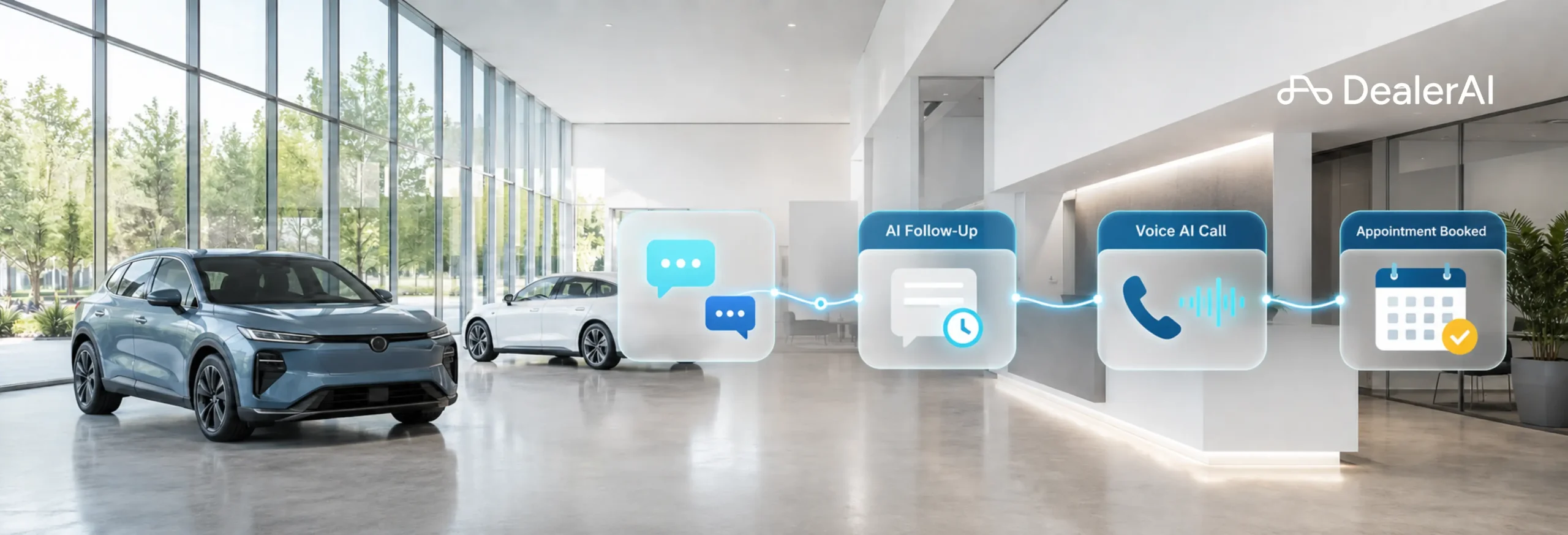
DealerAI supports connected conversations across webchat, SMS, email and phone. Reach handles automated SMS and email follow-up, while DealerAI Voice supports phone conversations. Supported workflows still depend on the dealership’s systems, data connections and configuration.
Finance agents can support dealership-approved reminders and routine status updates, while detailed credit questions should route to the finance office. Parts agents can answer approved questions and support order or pickup follow-up when reliable parts data is available. Without that connection, the request should go to the parts counter rather than rely on a guess.
Published DealerAI results currently focus mainly on sales follow-up. Campbell River Toyota, Courtenay Mazda and GAA Auto Sales appear in DealerAI’s case studies. Ask DealerAI or any vendor which workflows are active, integration-dependent or custom.
Frequently Asked Questions
Does One AI Tool Usually Cover Sales, Service, Parts and Finance Well?
Not always. Ask the vendor to demonstrate the trigger, data, message, stop rule and employee handoff for each area.
Should AI Collect Financial Documents From Customers Directly?
Approved reminders can be useful. Collecting sensitive documents or making credit decisions is different. Ask how information is secured and when F&I must take over.
What Is the Easiest Dealership Workflow to Start With?
Sales has the most public DealerAI proof. Service can also be practical because reminders and no-show recovery follow clear events.
What Should Stop an Automated Follow-Up?
The follow-up should stop or pause when the customer replies, books, completes the visit, buys, opts out or no longer matches the workflow. The exact stop conditions depend on the dealership’s process and connected systems.
Does an AI Follow-Up Tool Replace the Dealership CRM?
Not necessarily. A follow-up platform can work alongside the dealership’s CRM, DMS, scheduler and inventory systems. Management should confirm what data moves between the systems and where replies and outcomes are recorded.
What Is a Department-Specific AI Agent?
A department-specific AI agent is configured with the knowledge, data, rules and handoff points needed for a particular job. A service agent should not use the same information or limits as a sales, parts or finance agent.
Why Should Dealership AI Work Across Several Channels?
Customers may prefer SMS, email, webchat or phone at different points in the journey. A connected system can preserve the conversation when the channel changes, while respecting customer choice, consent and dealership rules.
Ask for the Workflow, Not the Claim
“Supports the whole dealership” sounds good in a vendor presentation. What matters is whether the vendor can show how each workflow actually operates.
Ask to see the trigger, data source, message, stop rule and employee handoff for sales, service, parts and finance. If one of those pieces is missing, the workflow may still depend on someone managing it manually.
If you want to estimate what stronger follow-up could be worth across your departments, try DealerAI’s ROI calculator. Or, book a demo to see how DealerAI handles different dealership workflows.