The best AI lead generation software for automotive dealerships depends on where opportunities are being lost. Some tools generate new traffic. Others turn existing website, phone, email, SMS and third-party leads into conversations and appointments. For an auto group, the strongest platform should also support rooftop-level routing, group inventory visibility, consistent follow-up and management oversight.
For most established auto groups, the bigger question is not only how to generate more leads. It is how to get more value from the leads every rooftop already receives.
This guide compares the main types of automotive AI lead platforms and the capabilities dealerships should evaluate. It does not rank individual vendors because the right fit depends on the dealership’s lead sources, workflows, systems and group structure.
What does AI lead generation software do for a car dealership?
AI lead generation software can help a dealership attract shoppers, capture their information or move an existing inquiry toward an appointment. The term covers several different types of automotive software. As a result, two products described as AI lead generation software for automotive dealerships may solve very different problems.
The main categories include:
- Advertising and audience tools that help dealerships find potential buyers and bring more traffic to their websites.
- Website conversion tools that turn VDP and website visitors into identifiable leads.
- Lead response platforms that answer questions, qualify intent and continue the conversation after an inquiry arrives.
- Follow-up and re-engagement tools that work fresh, unsold and aged leads over time.
- Automotive CRM tools that record lead activity, assign ownership and help managers track the sales process.
A dealership may need more than one category. Before comparing products, management should identify whether the main gap is lead volume, website conversion, response coverage, follow-up consistency or the movement from lead to appointment.
Is lead generation the same as lead management?
No. Lead generation creates or captures an opportunity. Lead management determines what happens after that opportunity enters the dealership.
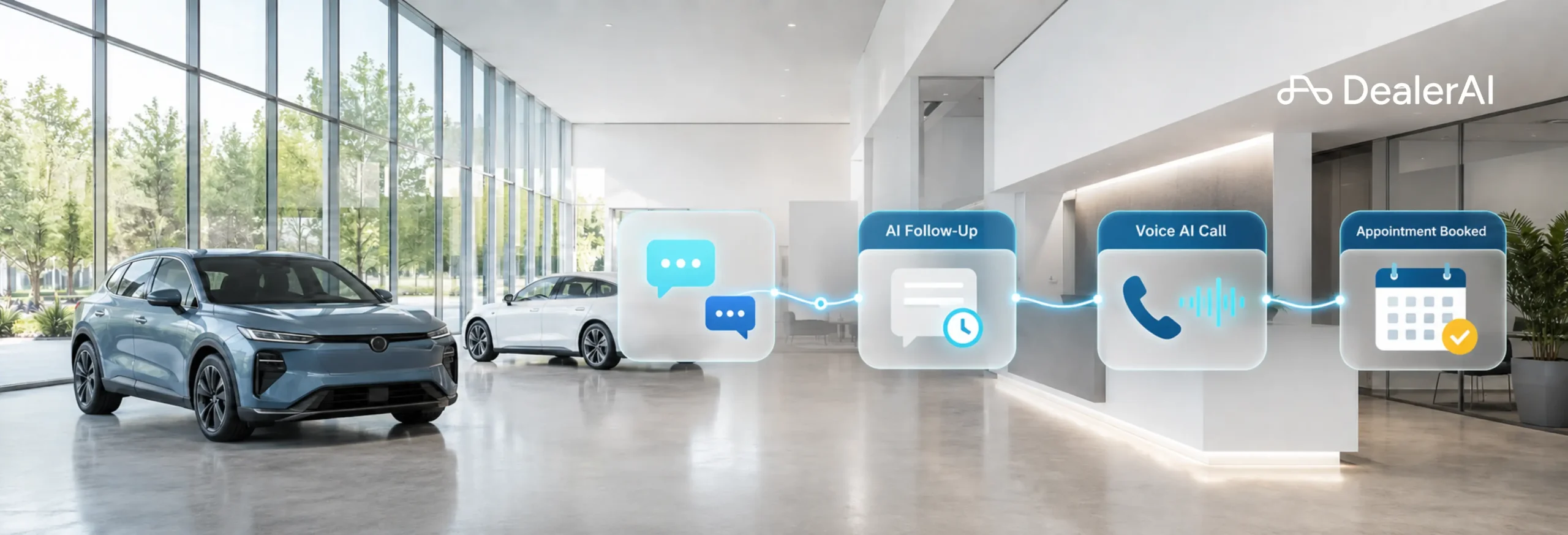
For example, a paid campaign may produce an internet lead. An AI lead management platform can then respond, answer the shopper’s vehicle questions, find a matching unit, collect any missing details, set an appointment and update the CRM.
This distinction matters at the group level. Adding more lead sources will not correct inconsistent handling between rooftops. If a group already has healthy traffic and lead volume, improving response, routing and follow-up may have a greater effect than buying another source of names.
What should an auto group expect from dealership AI?
An auto group needs more than a fast first reply. The platform must help move an opportunity through the group while respecting each rooftop’s operating rules.
Management should evaluate whether the AI can:
- Respond to website, third-party, email, SMS, social and phone inquiries
- Understand what the shopper is asking instead of sending a generic acknowledgement
- Answer questions using current dealership and inventory information
- Continue the conversation across multiple follow-up steps
- Set sales and service appointments
- Route leads according to rooftop, department, source, geography or other group rules
- Search for a suitable vehicle at another group store when the receiving rooftop is out of stock
- Preserve lead ownership and provide a clear handoff when another store has the match
- Write conversation details and outcomes to the CRM
- Give management visibility across stores, channels and departments
- Support different processes for sales, service, parts and finance
- Allow a dealership employee to take over with the full context available
The best system is the one that fits the group’s actual workflow. A long feature list matters less if the AI cannot follow the group’s routing rules, access the right data or show managers what occurred.
Why does consistency across rooftops matter?
The same lead can receive a very different experience depending on the store, time of day, lead source and person who receives it.
The 2026 Pied Piper Internet Lead Effectiveness Auto Dealer Group Study found dealer-group scores ranging from 54 to 93. The average group score increased by seven points, supported by more text responses, better multi-channel follow-up and fewer slow or unhelpful replies.
Its broader 2026 automotive industry study found that 51% of dealerships delivered what Pied Piper defined as a perfect response: answering the shopper’s question quickly and following up through multiple communication paths.
For group leadership, this is an operating issue. The objective is not to make every rooftop identical. It is to establish a dependable standard for the parts of lead handling that should not change:
- Every inquiry is recognized
- The shopper’s question receives a useful answer
- The right store or department owns the next step
- Follow-up continues according to the group’s rules
- The CRM reflects what happened
- Management can see the outcome
AI can help apply that standard while allowing each rooftop to keep its own team structure, lead routing and escalation process.
What is the best AI lead generation software for a single dealership?
When comparing AI lead generation software for automotive dealerships, a single rooftop should look for a platform that connects to its existing lead sources, inventory, appointment process and CRM. It should be able to handle common sales and service inquiries without forcing the store to rebuild its workflow around the software.
Important questions include:
- Can it answer model, trim, availability and dealership-policy questions accurately?
- Can it recognize when the customer is ready to set an appointment?
- Can it follow up through the channels the store already uses?
- Can management review conversations and outcomes?
- Can the AI transfer the customer to the right person when needed?
- Can the store adjust its knowledge, messaging and routing without a lengthy support process?
A website chatbot alone may capture contact information, but that does not mean the lead has been worked. The stronger measure is whether the platform advances the inquiry toward a clear next step.
What is the best AI lead generation software for an auto group?
For a multi-rooftop group, the best AI platform should connect the complete opportunity across stores. It needs to know where the lead arrived, which rooftop should own it, whether another store has a better inventory match and how management wants that opportunity handled.
The evaluation should extend beyond speed to lead.
| Management priority | What the AI platform should provide |
|---|---|
| Lead coverage | Consistent handling across web, email, SMS, social, phone and third-party sources |
| Rooftop control | Store-specific ownership, routing, escalation and appointment rules |
| Inventory utilization | The ability to locate suitable units across participating group stores |
| Customer continuity | Conversation context that carries into follow-up and human takeover |
| CRM discipline | Accurate lead details, conversation summaries, appointment outcomes and routing records |
| Group oversight | A group-level view of activity, performance and exceptions by store or channel |
| Department coverage | Workflows designed for sales, service, parts, finance and other dealership needs |
| Operational fit | Integration with existing systems without replacing the dealership CRM or DMS |
This is where automotive-specific AI differs from a general communication tool. Auto groups have inventory feeds, OEM and third-party leads, rooftop ownership rules, BDC processes, appointment types and CRM requirements that must work together.
How does DealerAI fit this category?
DealerAI is an AI-powered customer communication and lead workflow platform built for dealerships and auto groups. It is designed primarily to help dealers work and convert inbound opportunities, rather than serve as a paid advertising or prospect-list provider.
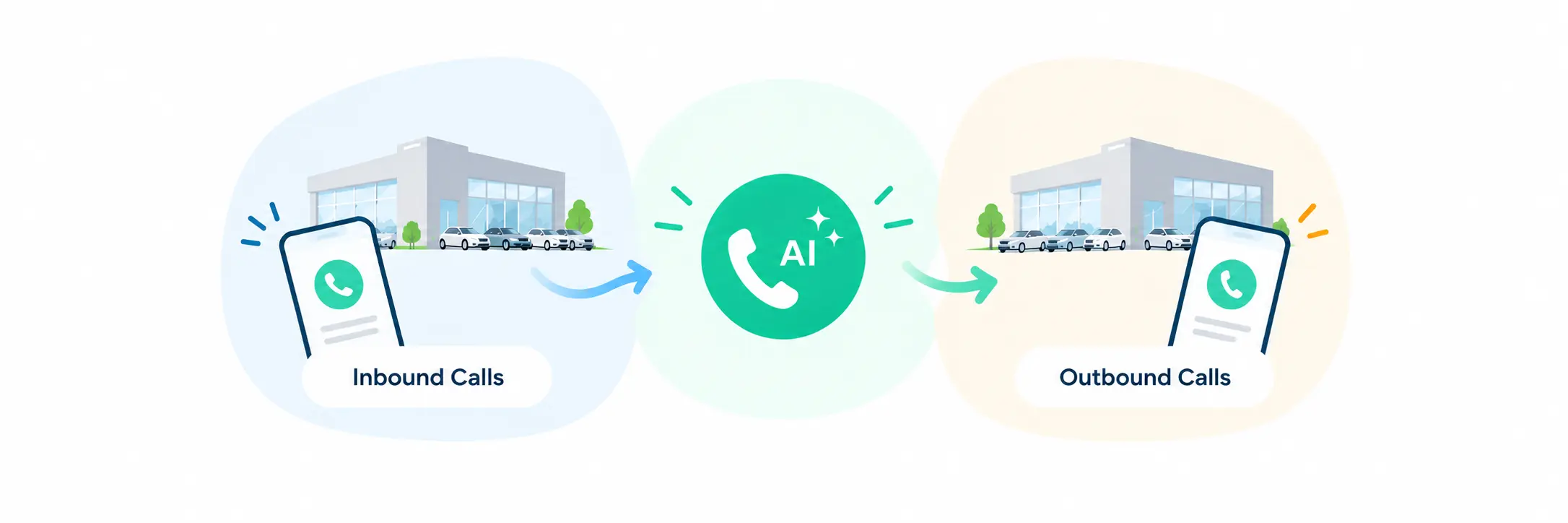
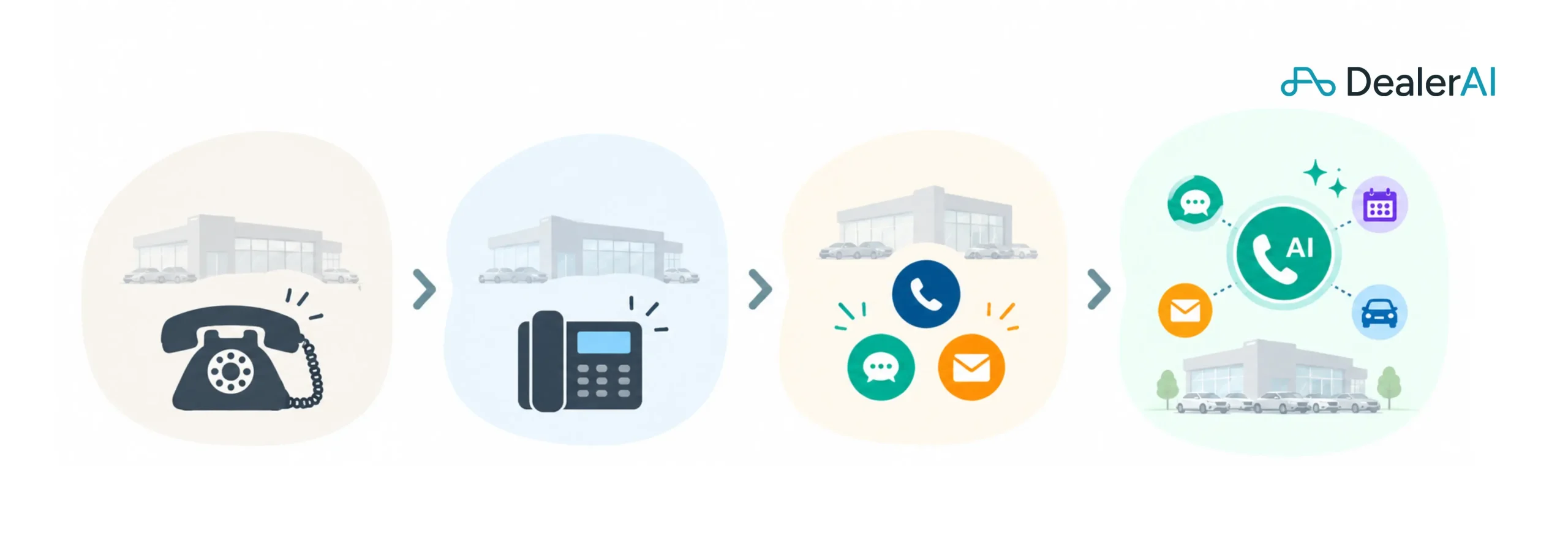
DealerAI can handle conversations across website chat, email, SMS, social messaging and phone. It answers shopper questions, checks inventory, collects lead details, sets sales or service appointments, continues follow-up and brings in dealership staff when the conversation requires a person.
For auto groups, DealerAI adds several management-level capabilities:
- Smart routing: Each rooftop can follow its own rules for lead ownership, department routing and human handoff.
- Fuse Inventory: When one store does not have the requested vehicle, DealerAI can search inventory across participating group rooftops and help connect the shopper with a suitable unit.
- Group-wide visibility: Leadership can oversee AI activity across connected stores rather than reviewing each rooftop in isolation.
- Specialized workflows: Different AI agents can support sales, service, finance, parts and other dealership functions.
- Conversation-aware follow-up: Automated follow-up can use the context of the original inquiry instead of restarting with a generic message.
- CRM workflow support: Lead details, conversation information and next steps can be routed into dealership systems based on the approved setup.
This makes DealerAI a strong fit for auto groups that already produce meaningful lead volume and want to improve how those opportunities move across channels, departments, inventory and rooftops.
It may not be the right category of product for a dealership whose only objective is to buy advertising or acquire cold prospect lists. In that case, a demand-generation or media platform may be the more appropriate first investment.
How should management compare AI lead generation software for automotive dealerships?
The evaluation should begin with real dealership scenarios, not a controlled demo alone.
Ask each vendor to demonstrate how its system handles situations such as:
- A shopper asks about a specific trim that the receiving rooftop does not have.
- A website lead starts on chat, replies later by SMS and then calls the store.
- A third-party lead asks a detailed question instead of replying to a standard template.
- A service customer needs an appointment but also asks about trading the vehicle.
- One rooftop wants leads routed to the BDC, while another wants direct assignment to the sales floor.
- A shopper stops responding after discussing a particular vehicle and payment concern.
- Group management needs to understand which store, channel and workflow produced the appointment.
The vendor should be able to show the answer, action, routing, CRM record and management view for each scenario.
Which results should an auto group measure?
AI performance should connect to operating and sales outcomes. Management should establish a baseline before launch and compare results by rooftop, channel and lead source.
Useful measures include:
- Median time to a useful first answer
- Percentage of leads receiving a complete response
- Percentage of inquiries answered through more than one channel when appropriate
- Lead-to-conversation rate
- Conversation-to-appointment rate
- Appointment set, shown and sold rates
- Follow-up completion rate
- Re-engagement of unsold and aged leads
- Cross-rooftop inventory matches and resulting appointments
- Correct lead-routing rate
- Human takeover and escalation outcomes
- CRM record completeness
- Performance consistency between rooftops
The Cox Automotive AI Readiness in Auto Retail Study reported that 81% of dealers believe AI is here to stay, while 63% believe investing now is important for long-term success. The useful management question is therefore becoming less about whether a platform uses AI and more about which dealership outcomes it can improve and verify.
The best platform depends on the gap management needs to close
There is no single AI lead generation platform that is best for every dealership. The right AI lead generation software for automotive dealerships depends on the operating gap management needs to close.
If the group needs more traffic, it should evaluate advertising and demand-generation tools. If website visitors are not becoming identifiable leads, it should examine conversion tools. If leads are entering the group but response, routing, inventory matching and follow-up vary between rooftops, an automotive AI lead workflow platform is the closer fit.
For established auto groups, the strongest platform is often the one that helps the organization make better use of opportunities it already owns. That means connecting the first inquiry to the right answer, the right vehicle, the right rooftop, a booked appointment and a complete CRM record.
Frequently asked questions
Can AI generate leads for a car dealership?
Yes. AI can support audience targeting, advertising, website engagement and lead capture. It can also help convert existing traffic by starting conversations, answering questions and collecting contact information. Dealerships should confirm whether a product generates new demand or primarily handles leads created by existing marketing sources.
Can dealership AI respond to internet leads automatically?
Yes. Automotive AI can respond to website forms, OEM leads and third-party internet leads through email or SMS, depending on its integrations. More capable systems can understand the shopper’s question, use inventory and dealership information, continue the exchange and set an appointment.
Does an AI lead platform replace the dealership CRM?
Usually not. An AI lead platform commonly works alongside the CRM. The AI handles conversations, qualification, routing or follow-up, while the CRM remains the dealership’s system of record for ownership, activity and sales process management.
Can one AI platform support several dealerships in an auto group?
Yes, but group capability varies by vendor. Management should verify whether the platform supports different routing rules by rooftop, shared inventory searches, group-level reporting, department-specific workflows and clear ownership when an opportunity moves between stores. DealerAI, for example, includes Fuse Inventory, which lets a rooftop search matching units across other stores in the group when it doesn’t have the shopper’s requested vehicle in stock, while still preserving lead ownership for the originating store.
Should a dealership choose the AI platform with the fastest response?
Response speed matters, but it is not enough by itself. A fast generic message may still leave the shopper waiting for an answer. Management should evaluate answer quality, inventory access, follow-up, routing, appointment completion, CRM integration and measurable results alongside response time.
What is the difference between an AI chatbot and an AI lead workflow platform?
An AI chatbot mainly handles conversations within a chat interface. An AI lead workflow platform can connect conversations with actions such as lead routing, inventory searches, appointment booking, multi-channel follow-up, CRM updates and human handoff. DealerAI is built around this broader definition, working across webchat, SMS, email, inbound and outbound voice, and Facebook inbox, with each conversation tied to routing and CRM outcomes rather than living only in a chat window. Car dealerships should evaluate the complete workflow rather than the chat window alone.
See how DealerAI works across an auto group
Explore how DealerAI connects lead response, follow-up, inventory matching and appointment workflows across participating rooftops.