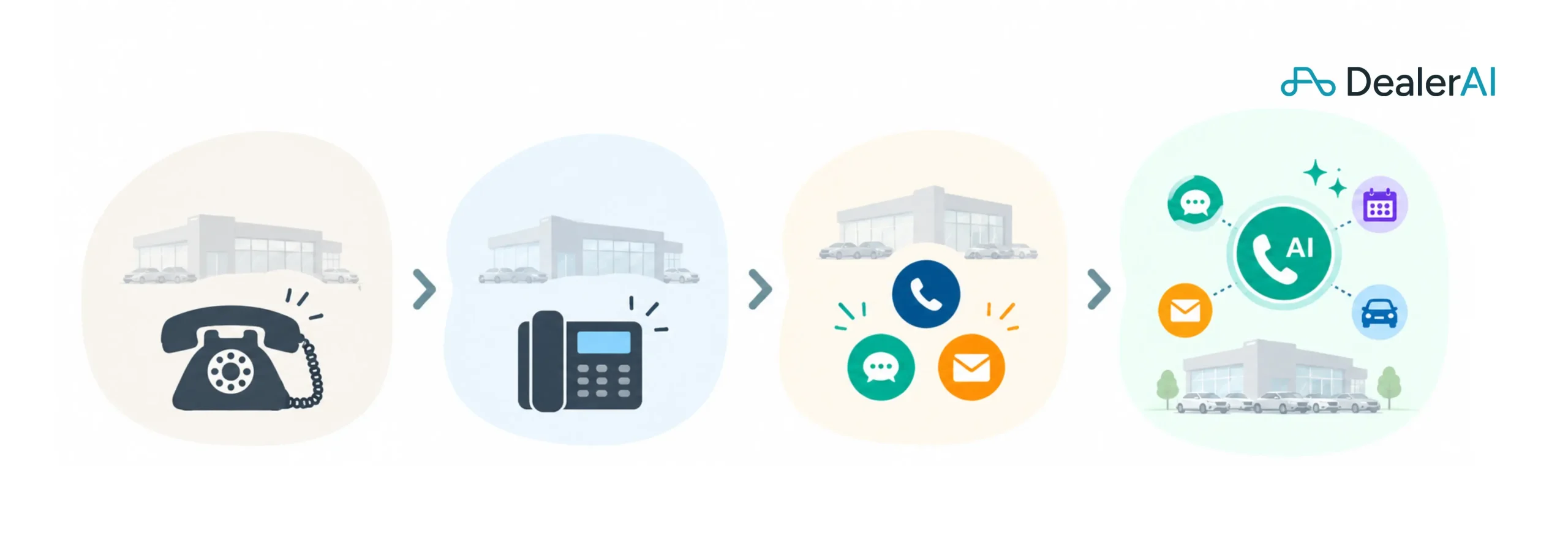
For decades, dealership phone capacity has been closely tied to employee time. If more customers call, more people need to answer. If a dealership wants to increase outbound follow-up, BDC representatives need enough time to make those calls. Longer hours, higher lead volume and additional rooftops all increase the communication workload.
The phone itself is not becoming less important. CDK Global reported in 2026 that 47% of customers book sales appointments by phone and 61% book service appointments that way. The same research found that 29% of service shoppers had difficulty scheduling by phone, while the average dealership service hold time reached 9.3 minutes. (Source: CDK Global)
For dealership leadership, that creates a bigger question than simply how to answer more calls.
How can the business increase communication capacity without increasing phone staffing at the same rate?
That is where AI phone service for dealerships starts to become an operating strategy rather than another technology feature.
Phone Capacity Has a Cost
A dealership phone operation works in two directions.
Customers call into sales, service and parts with questions, appointment requests and existing business. At the same time, BDC and sales teams make outbound calls to internet leads, no-shows, older CRM opportunities and customers who require follow-up.
Both depend on employee availability.
Car Wars analyzed phone activity from nearly 3,000 U.S. dealerships during 2024. It found that 31.8% of unconnected calls ended because customers hung up while on hold, with average hold time reaching 3 minutes and 5 seconds. The same analysis identified 10 a.m. to noon as the busiest inbound period. (Source: Car Dealership Guy News)
Outbound calls create a different version of the same constraint. A BDC representative can only complete a certain number of meaningful conversations during a shift. As new leads and follow-up lists accumulate, some opportunities naturally receive more attention than others.
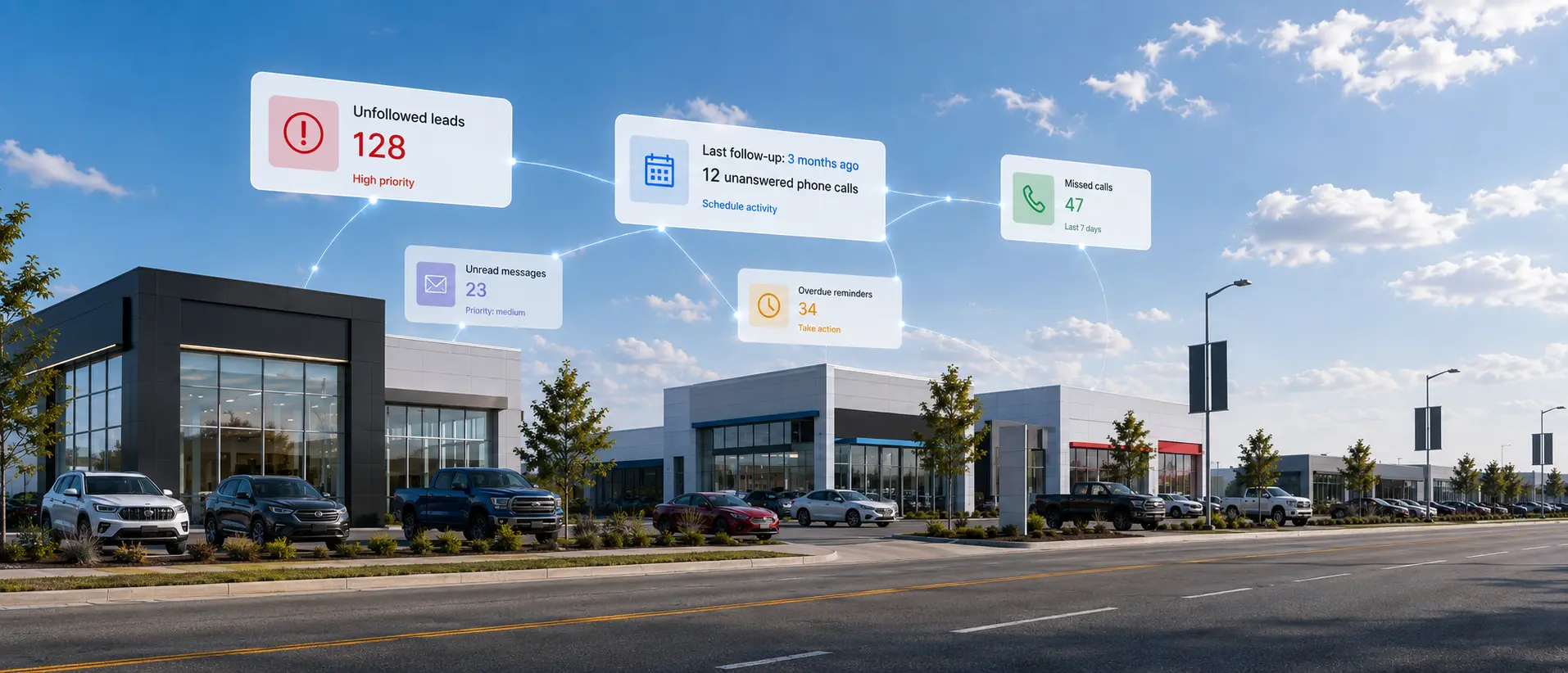
These gaps are often difficult for management to see. An inbound caller may disconnect before becoming a CRM lead. An older prospect may remain in the database without another meaningful conversation.
Across several rooftops, small gaps like these can become a significant amount of unused opportunity.
AI Changes the Economics of Phone Capacity
Traditional phone operations generally require additional employee time as communication volume grows.
AI introduces a different model.
Conversational systems can support multiple appropriate conversations at the same time, extend coverage outside normal business hours and take on repetitive outbound activity without assigning every interaction to an employee from the beginning.
That does not mean AI automatically reduces dealership costs. The stronger business case is that it can lower the incremental cost of adding communication capacity.
If a group adds stores, increases marketing volume or wants to work more of its CRM database, phone activity does not necessarily have to create the same proportional increase in employee phone time.
For an owner or group executive, that changes the economics of growth.
Control the Cost of Adding Capacity
Dealerships traditionally have several ways to increase phone coverage. They can add employees, extend shifts, centralize more activity through a BDC or accept that certain calls and follow-up attempts will have to wait.
AI provides another option.
Routine inquiries, initial qualification, appointment requests and appropriate follow-up conversations can be handled without requiring another employee to become available for each call.
The business value is not about eliminating the people already doing the work. It is about adding capacity around them.
A growing dealer group can therefore handle more communication without requiring phone staffing to expand at exactly the same pace.
Put Employee Time Where It Creates More Value
The cost of a phone call is not limited to telecom expenses. It also includes employee time.
A service advisor looking up information for routine questions is not working on another service customer. A salesperson repeatedly calling leads who do not answer is not speaking with an active buyer. A BDC representative handling basic questions has less time for opportunities that require persuasion, judgement or a personal relationship.
AI can absorb appropriate parts of that workload and prepare better information before an employee steps in.
The objective is simple: use people where people create the most value.
Negotiations, complex service issues, customer recovery, management decisions and relationship-building remain human work. Routine communication does not always need to begin there.
Engage More of the Opportunities You Already Have
Dealerships spend heavily to generate customer demand, but not every opportunity arrives as a new lead today.
There are previous internet leads, unsold prospects, missed appointments, service customers, prior buyers and older CRM records already inside the business.
The challenge is often maintaining enough communication with all of them.
AI phone service creates additional capacity for both inbound and outbound engagement. A dealership can respond when a customer calls while also increasing the portion of its existing database that receives timely follow-up.
This is particularly relevant as AI becomes more common in automotive retail. Cox Automotive reported in August 2026 that 82% of dealers were already using AI. Task automation and customer follow-up were tied as the most common applications, each used by 40% of dealers surveyed. Improved customer experience and employee productivity were among the benefits dealers reported most often. (Source: Cox Automotive)
The business case, however, should not be measured by how much AI a dealership uses. It should be measured by how much more effectively the dealership works the opportunities it already has.
Build More Consistency Across Rooftops
A single dealership may be able to solve a phone issue by changing staffing at a particular department or time of day. The challenge becomes more complicated across an auto group.
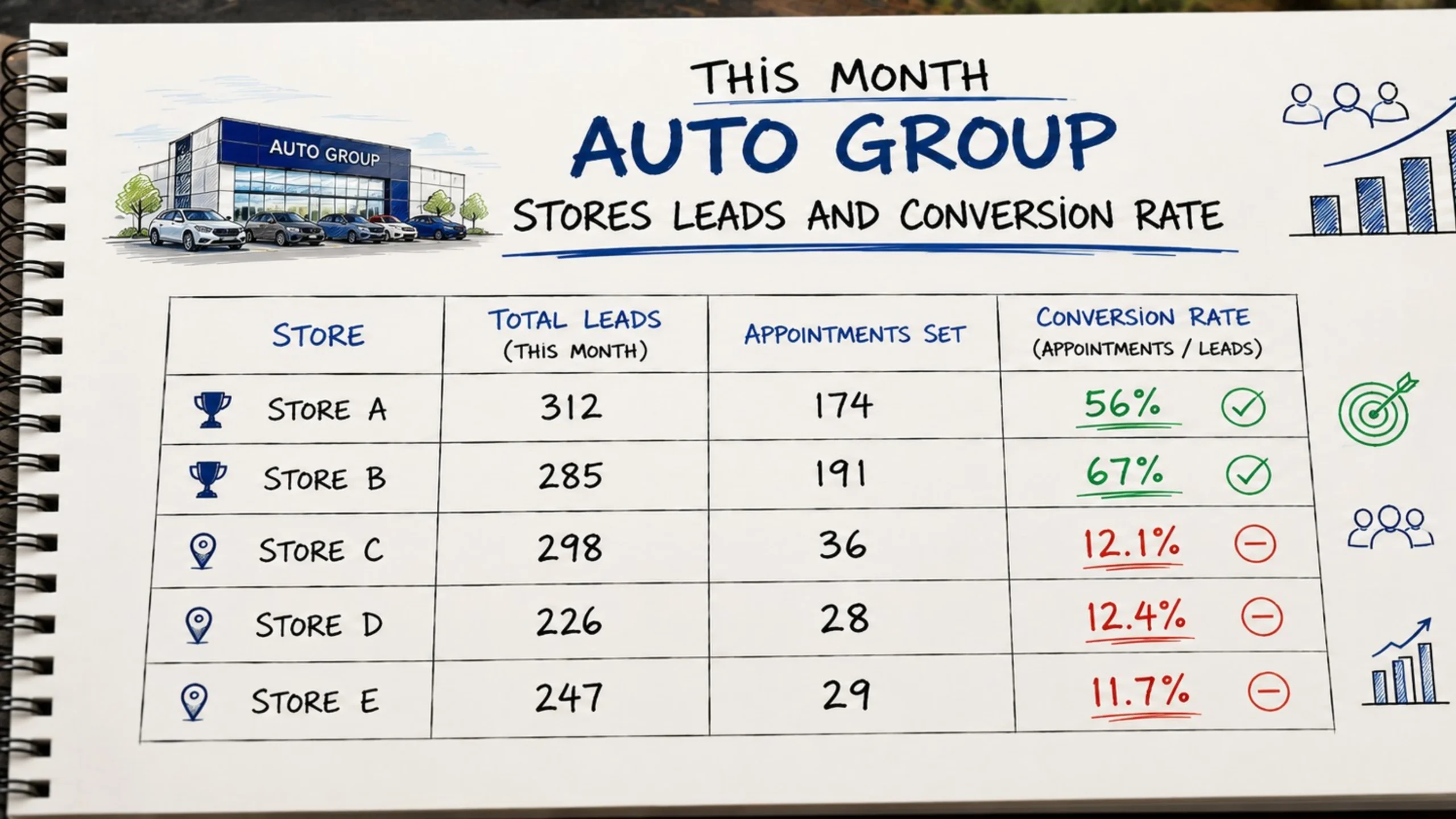
One rooftop may have a large BDC. Another may rely more heavily on salespeople. One service department may have strong bilingual coverage, while another depends on a small number of employees. Peak periods can also vary by location.
AI allows group leadership to establish a common communication layer while preserving those local differences.
Standards for answering, qualification, routing, escalation, after-hours coverage and outbound follow-up can be designed at the group level. Individual stores can still retain their own people, inventory, departments, languages and operating processes.
That combination of group consistency and local flexibility is where the model becomes particularly useful for multi-rooftop organizations.
Where DealerAI Voice Fits
DealerAI Voice is designed to add that communication capacity across dealership sales, service and parts.
For inbound calls, Voice can support conversations, retrieve dealership information and perform connected actions through CRM, DMS, inventory and service systems where integrations are available. It also supports more than 30 languages and can provide overflow and after-hours coverage.
The same approach can extend to outbound activity.
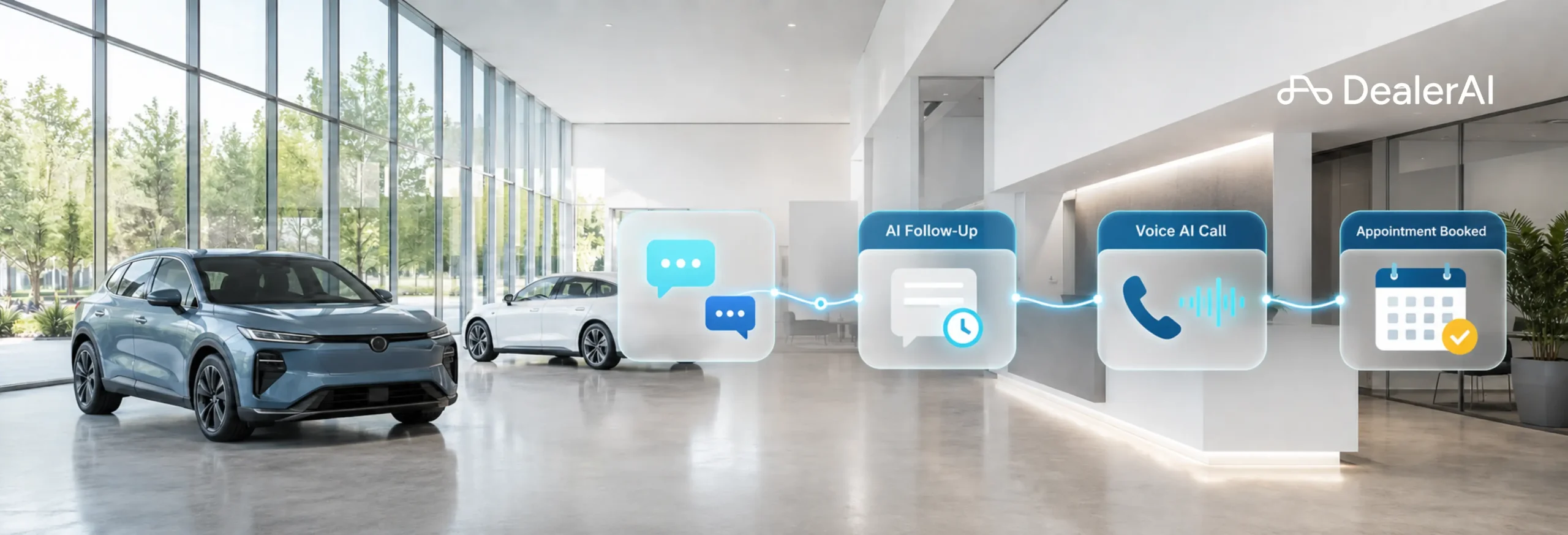
DealerAI Reach brings voice, SMS and email into coordinated follow-up sequences, allowing dealerships to build communication around the customer rather than treating each channel as a separate process. (Source: DealerAI)
That means the phone becomes part of a broader customer communication strategy rather than an isolated channel.
The Human Handoff Still Matters
Adding AI capacity does not make the existing operation irrelevant. In fact, the handoff between technology and employees becomes more important.
Pied Piper’s 2026 dealer-group service research found that roughly one in three attempted AI-to-human transfers failed through voicemail, disconnection or extended hold. The research also found significant differences between top- and lower-performing dealer groups in how quickly customers reached service employees and successfully arranged service. (Source: Pied Piper PSI)
That is an important lesson for leadership.
A sophisticated AI conversation can still produce a poor experience if the customer reaches the wrong person, waits too long after the transfer or has to repeat everything again.
Successful phone automation therefore requires good routing, clear escalation rules and a strong operating process around the technology.
Measure the Business Outcome
Cox Automotive’s 2026 AI research found a clear measurement gap. While 69% of dealers expected AI to contribute to sales and revenue growth, only 22% of AI users reported seeing that growth at the time of the survey. About one-third either were not measuring AI impact or lacked clarity around their measurement approach. (Source: Cox Automotive)
That makes measurement especially important for phone automation.
| Business area | What leadership should measure |
|---|---|
| Coverage | Answer rate, abandoned calls, after-hours coverage |
| Efficiency | Hold time, employee phone time, conversations handled |
| Outbound | Contact rate, follow-up coverage, successful conversations |
| Sales | Qualified opportunities, appointments, show rate |
| Service | Appointments booked, transfer success |
| Customer experience | Repeated transfers, abandoned interactions |
| Economics | Cost per conversation and cost of adding capacity |
The goal is not to prove that an AI voice sounds impressive. It is to determine whether the new operating model improves the dealership.
A Phone Operation Built for Growth
The larger opportunity is not replacing a receptionist, BDC representative or service advisor with AI.
It is changing the relationship between business growth and communication capacity.
Dealerships can use AI to extend coverage, work more opportunities and absorb appropriate routine conversations while employees spend more time on customers who need their experience.
For a single dealership, that can improve phone efficiency. Across an auto group, it can become a scalable operating model.
That is the business case for DealerAI Voice.
Talk to Sarah
The easiest way to understand the difference is to experience the conversation yourself.
Call 289-277-8899 and speak with Sarah, DealerAI’s Voice demo AI agent. Ask about a vehicle, service, inventory or another common dealership question.
Then consider a more important question:
Where could this type of capacity create the most value across your operation?
FAQs
What is AI phone service for dealerships?
AI phone service uses conversational AI to support inbound and outbound dealership calls. Depending on the connected systems, it can answer questions, retrieve information, qualify inquiries, support appointments and hand conversations to employees.
Can AI phone service reduce dealership operating costs?
It can reduce the incremental cost of adding phone capacity by automating appropriate conversations and reducing routine employee phone work. Actual savings depend on call volume, workflow design, integrations and the dealership’s existing staffing model.
Does AI phone service replace a dealership BDC?
It does not need to. AI can support overflow, routine communication and outbound follow-up while BDC employees focus on conversations that require judgement, selling skills or personal attention.
Why is AI phone service useful for auto groups?
Auto groups can create common standards for phone coverage and follow-up across rooftops while allowing each dealership to retain its local staff, inventory, languages and operating processes.